Valley Strike – Painting the Harrier

Some paintings start with an aircraft I want to capture. Others have a much more personal connection behind them.
“Valley Strike” was inspired in part by my friendship with retired RAF Squadron Leader David Linney, someone I fly with at Middlezoy Aerodrome and for whom I have a great deal of respect. David flew and commanded Harrier GR3 reconnaissance operations in West Germany during the Cold War, and hearing about that world of low-level tactical flying gave me the inspiration to paint the aircraft in the environment with which it became so closely associated.
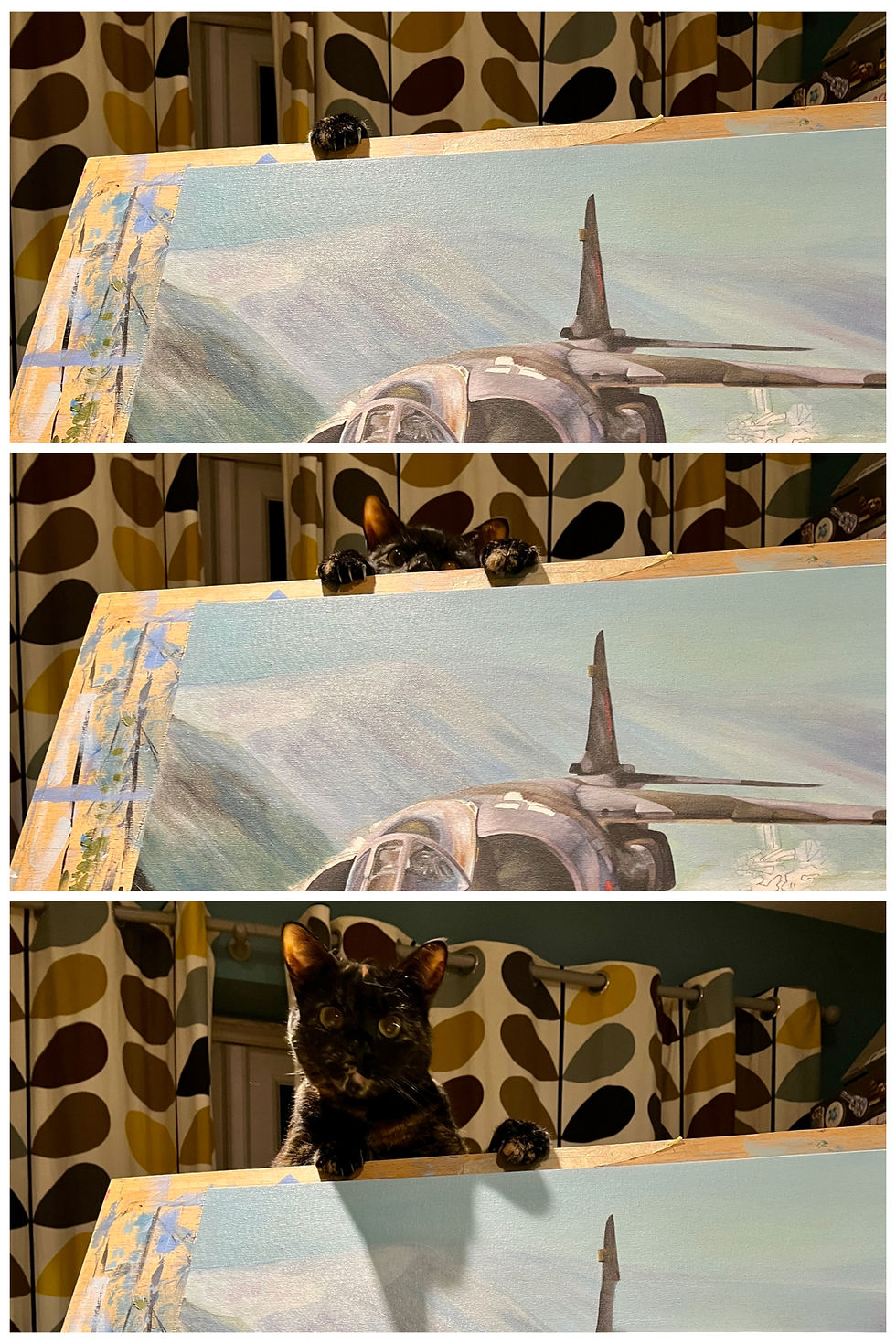
The painting depicts a No. 4 Squadron RAF Harrier GR3, hard down in a Welsh valley, banking through the terrain with the mountains rising behind it.

The Harrier at low level
Today the Harrier is probably remembered above all for its extraordinary ability to take off and land vertically. But that can sometimes overshadow what the RAF actually expected the aircraft and its pilots to do operationally.
During the Cold War, RAF Harriers were based in West Germany as part of NATO's tactical air forces. Their roles included close air support, battlefield interdiction and tactical reconnaissance. No. 4 Squadron was specifically assigned both attack and tactical reconnaissance duties. (RAF Museum)
The whole concept was designed around survivability. In the event of war, Harriers could disperse away from vulnerable conventional airfields and operate from temporary sites closer to the front line. The RAF Museum records how the aircraft could be hidden in camouflaged sites and operated from short strips, ready to support forces facing a Warsaw Pact advance. (RAF Museum)
Once airborne, staying low was equally important.
For reconnaissance in particular, the GR3 could carry a dedicated camera pod, and low-level flying was central to the way the aircraft was intended to survive in a heavily defended environment. (RAF Museum)
It required a very particular kind of flying – fast, low and close to the terrain.
Inspiration closer to home
That's where my connection with David made this painting more than simply another picture of a Harrier.
I know David through Middlezoy Aerodrome in Somerset, where I fly myself. He is one of the people responsible for leading the aerodrome, and over the years I've had the privilege of flying with him and hearing something of his RAF career.
There's inevitably a difference between reading about Cold War operations in a book and knowing somebody who actually did it.
David's experiences with the Harrier GR3 and tactical reconnaissance in Germany gave me a much stronger appreciation for the skills demanded of the pilots flying these aircraft. It was a world of map reading, navigation, speed and very low-level flight, with the possibility that those skills might one day have been required for real against Warsaw Pact forces.
No. 4 Squadron itself had a long association with RAF Germany. It converted to the Harrier in 1970, initially operating from RAF Wildenrath before moving to RAF Gütersloh in 1977, where its Harriers remained throughout the latter part of the Cold War. (RAF Museum)

Composition
For the painting, I wanted to put the viewer down in the valley with the aircraft.
The Harrier is therefore large in the composition and coming almost directly towards us rather than being shown as a distant aircraft against a large landscape. The mountains rise behind and alongside it, giving a sense that the aircraft is flying through the terrain rather than safely above it.
I chose a Welsh valley as the setting because it immediately evokes the sort of demanding low-level environment in which generations of RAF fast-jet crews trained.
The Harrier itself has such an unusual shape that this head-on three-quarter view was particularly interesting to paint. The enormous intakes dominate the fuselage, while the outriggers, pylons and stores give it the purposeful, slightly ungainly appearance that makes the early Harriers so distinctive.
I also deliberately kept some of the landscape looser and more impressionistic. The aircraft needed to have solidity and detail, while the ground beneath it needed to feel as though it was disappearing rapidly behind.
The result was “Valley Strike.”

And then the painting found the right owner
There was a rather satisfying final chapter to this particular painting.
Having been partly inspired to paint it through knowing David and hearing about his experiences with the Harrier, David eventually bought the finished painting himself.
As an aviation artist, I can't think of a much better endorsement.
It's one thing for somebody to like a painting of an aeroplane. It's quite another when the person who chooses to hang it on their wall is somebody who actually flew the type operationally and understands exactly what that world of low-level Harrier flying was like.
So although Valley Strike depicts a No. 4 Squadron GR3 carving its way through a Welsh valley, for me the painting will always have another association too.
It's a small tribute to the aircraft, the extraordinary era of Cold War low-level flying, and to a pilot I'm very pleased to call a friend.


Comments